Lewis's brother
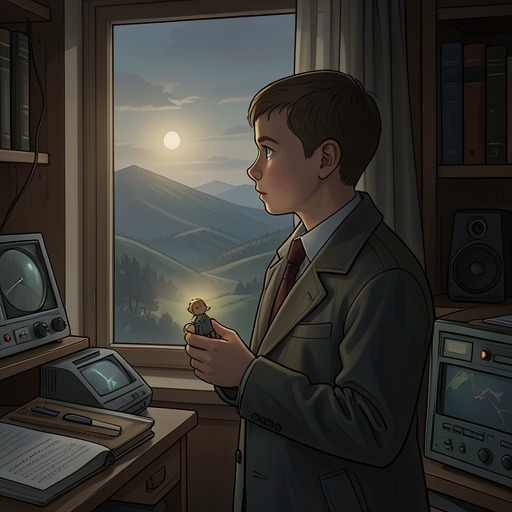
Surprised by JoyLewis’s brother, three years older than C. S. Lewis, was his first ally and creative partner. Their relationship joined distinct imaginations into a common world: his brother supplied ships, trains, battles, and India, while Lewis made Animal-Land and dressed animals. The collaboration shaped both their play and the remembered landscape of Lewis’s imagination, and their closeness became a refuge when their family life was transformed by their mother’s illness and death.
Identity and Early Relationship
Lewis recalls that his brother never seemed like an elder in the ordinary sense. From the beginning, they were allies, even confederates. Their closeness did not depend on being alike; it grew alongside a clear difference in what each boy drew and imagined. His brother’s earliest pictures featured ships, trains, and battles. Lewis’s, when not imitations of his brother’s, showed anthropomorphized animals, which the boys called dressed animals.
The brother was also the first to move from drawing to writing. His earliest story was called The Young Rajah, and he had already made India his imagined country. Lewis, by contrast, claimed Animal-Land as his own. The distinction gave each boy a recognizable imaginative territory, but it did not keep their play separate: in the holidays, when his brother was home, Animal-Land had to accommodate the modern inventions that made it a country they could share.
Shared Worlds and Creative Collaboration
Their make-believe developed through an exchange between Lewis’s medieval stories and their joint, more modern play. Lewis wrote and illustrated stories about chivalrous mice and rabbits in full armor, who rode out to kill cats rather than giants. He then connected this medieval Animal-Land to the modern version used in their holiday play, reasoning that they must be the same country at different historical periods. That effort to connect one imaginative era to another led him from storytelling into an attempt at writing a history of Animal-Land.
The brother’s inventions helped make that world larger and more coherent. After Lewis tried to construct Animal-Land’s history, he made maps of it, several of them, and related its geography to his brother’s India. India was shifted out of its place in the real world and made an island, with its north coast running along the Himalayas. Between India and Animal-Land, his brother rapidly devised the principal steamship routes. What began as separate childhood interests had become a shared geography, eventually a whole mapped world painted in every color in Lewis’s paintbox and populated with characters the boys kept consistent.
Their collaboration also carried a touch of critical distance. Lewis remembered that his histories treated the chivalric adventures as material that might be only legends, rather than simply presenting them as established fact. The surviving account credits Lewis with that historical qualification, while showing his brother’s larger contribution to the shared setting through India and the connecting steamship routes. Their world was therefore both imaginative play and an early exercise in making inventions fit together.
The Toy Garden and Imaginative Legacy
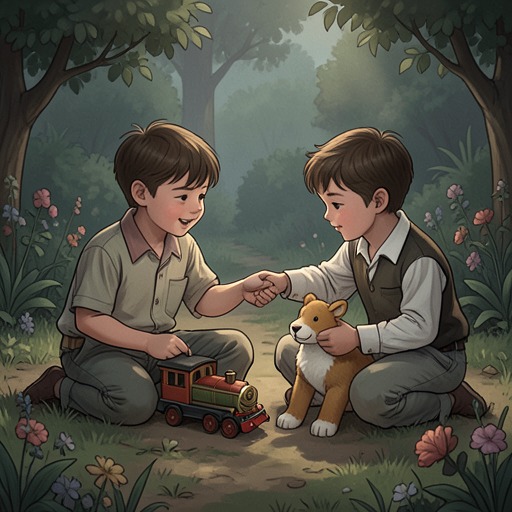
One of his brother’s most consequential contributions was not a story or a map but a small handmade landscape. He brought a biscuit-tin lid into the nursery and covered it with moss, twigs, and flowers, turning it into what the boys called a toy garden or toy forest. Lewis remembered this as the first beauty he knew. The actual garden where the boys played had not, in itself, awakened the same response; the miniature arrangement made him notice nature as cool, fresh, and exuberant rather than as a collection of forms and colors.
Lewis later gave the toy garden a lasting imaginative significance. Though he did not think its effect had seemed important at the time, it became important in memory, and he said his imagination of Paradise would retain something of his brother’s creation. The brother thus appears not only as a companion in inventing countries but also as the maker of an object through which Lewis first registered a particular kind of beauty.
Family Loss and Mutual Reliance
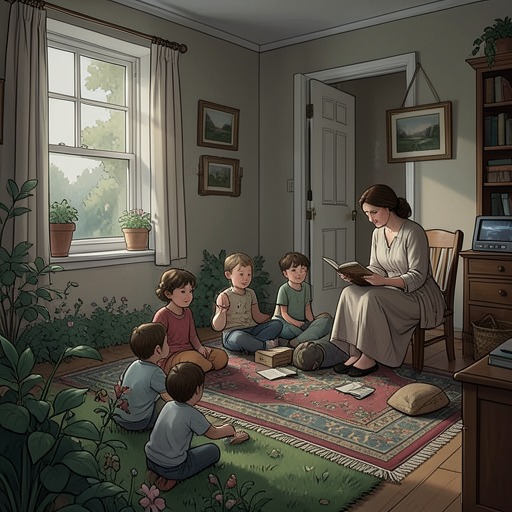
The brothers’ alliance became more decisive during their mother’s illness. As she was increasingly withdrawn from their lives into medical care, the household changed in ways the boys experienced as strange and threatening. Lewis recalls that this process had the effect of dividing the children from their father as well as from their mother. Their father’s distress and unpredictable temper made the boys less able to rely on him, and Lewis believed that he and his brother were learning to lie to him.
In that period, they came to rely more exclusively on one another for what made life bearable. Lewis describes their confidence as concentrated in each other: everything that had made the house a home seemed to have failed them except their companionship. He remembers them drawing closer day by day, two frightened boys seeking warmth in a bleak world. Their shared childhood invention therefore has a counterpart in a more urgent form of solidarity: the brother who had helped build imaginative worlds became the person Lewis could trust through a family crisis.
Narrative Significance
Lewis’s brother is characterized chiefly through companionship, creative difference, and practical imaginative influence, rather than through a separate account of his adult life. His India and Lewis’s Animal-Land remain distinct beginnings, but their maps, routes, histories, and characters show how each boy’s invention enlarged the other’s. The boy who imagined ships and trains helped make Lewis’s private animal country part of a wider, connected world.
The remembered details also link the brother to two different kinds of lasting consequence. His shared play helped establish Lewis’s earliest habits of world-building; his toy garden became part of Lewis’s later imaginative conception of Paradise. When bereavement altered the family, the brothers’ closeness shifted from creative alliance to mutual support. Across these changes, Lewis presents his brother as the earliest companion who helped make both an imagined world and a bearable home.